

Marigold Orange and Yellow No Zari Handwoven Kanjivaram
Marigold Orange and Yellow No Zari Handwoven Kanjivaram
Couldn't load pickup availability
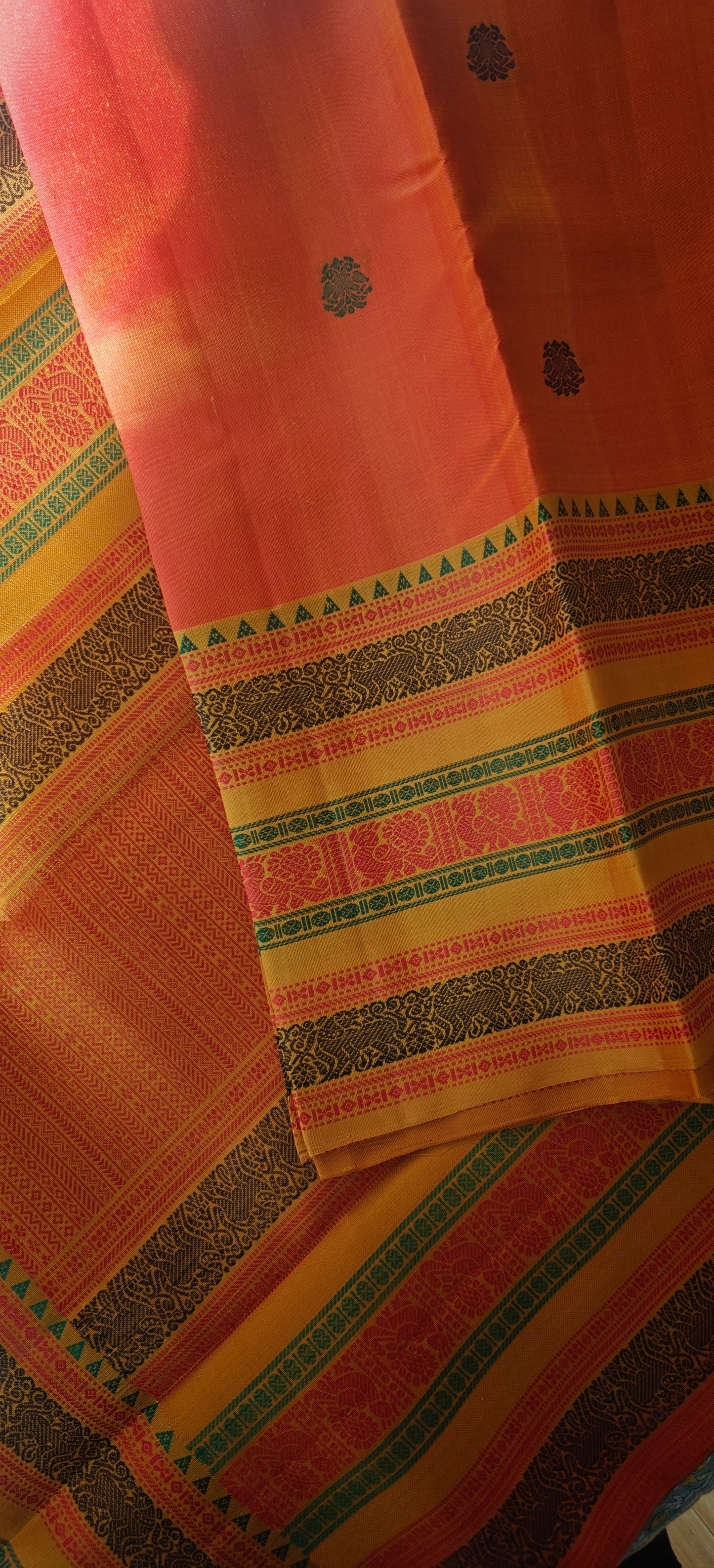
This marigold orange Kanjivaram wraps you in the glow of festival light—a colour that sits at the threshold between autumn and celebration, familiar yet unmistakably luxurious.
Across the body, the gandaberunda—the divine two-headed eagle—holds court in subtle, dignified buttis. There is no glitter here, only the quiet authority of hand-woven silk and the craft that knows when restraint speaks louder than ornamentation.
The border transforms into a symphony of colour: deep zari work sketches intricate geometric borders while peacocks emerge in the classic Kanjivaram rhythm, their forms dancing across stripes of mustard, coral, and charcoal. Layers of woven detail—each stripe a deliberate conversation between the weaver's hands and the loom.
The blouse arrives in matching marigold yellow, a gentle echo of the saree's warmth.
This is not a saree for the sidelines. It moves as you move, catches light as you turn, and announces that you understand the difference between decoration and design.
Weave details
Zari grade: No Zari kanjivaram
Note: Handloom saris are works of art and may carry minor pulls or irregularities — this is the mark of the handwoven, not a flaw. Colours may vary slightly across devices due to screen calibration.
Share this with your friends


Why this price?
Every piece at Indriya is handwoven by skilled artisans — we curate thoughtfully from our weaver clusters across India, having worked with 16+ craft clusters so far. Our zari grading is honest: 3-gram zari and above contains significant silver along with gold, while 2-gram zari is silk thread electroplated with gold. Techniques like kai korvai, where the weaver interlaces borders by hand without a single join, can take days on a single saree. We source directly and offer fair pricing — because handloom should be accessible, not aspirational.